
A Wet Spot That Won't Dry, or One Weak Sprinkler Zone
Step on the lawn two days after the sprinklers ran. If one spot gives under your shoe and water seeps up around it while the rest of the yard is firm, that water isn't left over from the schedule. It's coming up from a pipe.
The dry months make it easy to spot. Downtown Los Angeles gets almost no rain from May through September, so a damp patch in early fall rarely has the weather to blame. The other sign is quieter. One zone that used to throw water to the fence now barely clears the grass, while the zones on either side look normal. Both usually mean a lateral line has cracked and part of that zone's water is going into the soil instead of the heads. When there's a tree nearby, its roots are the first suspect.
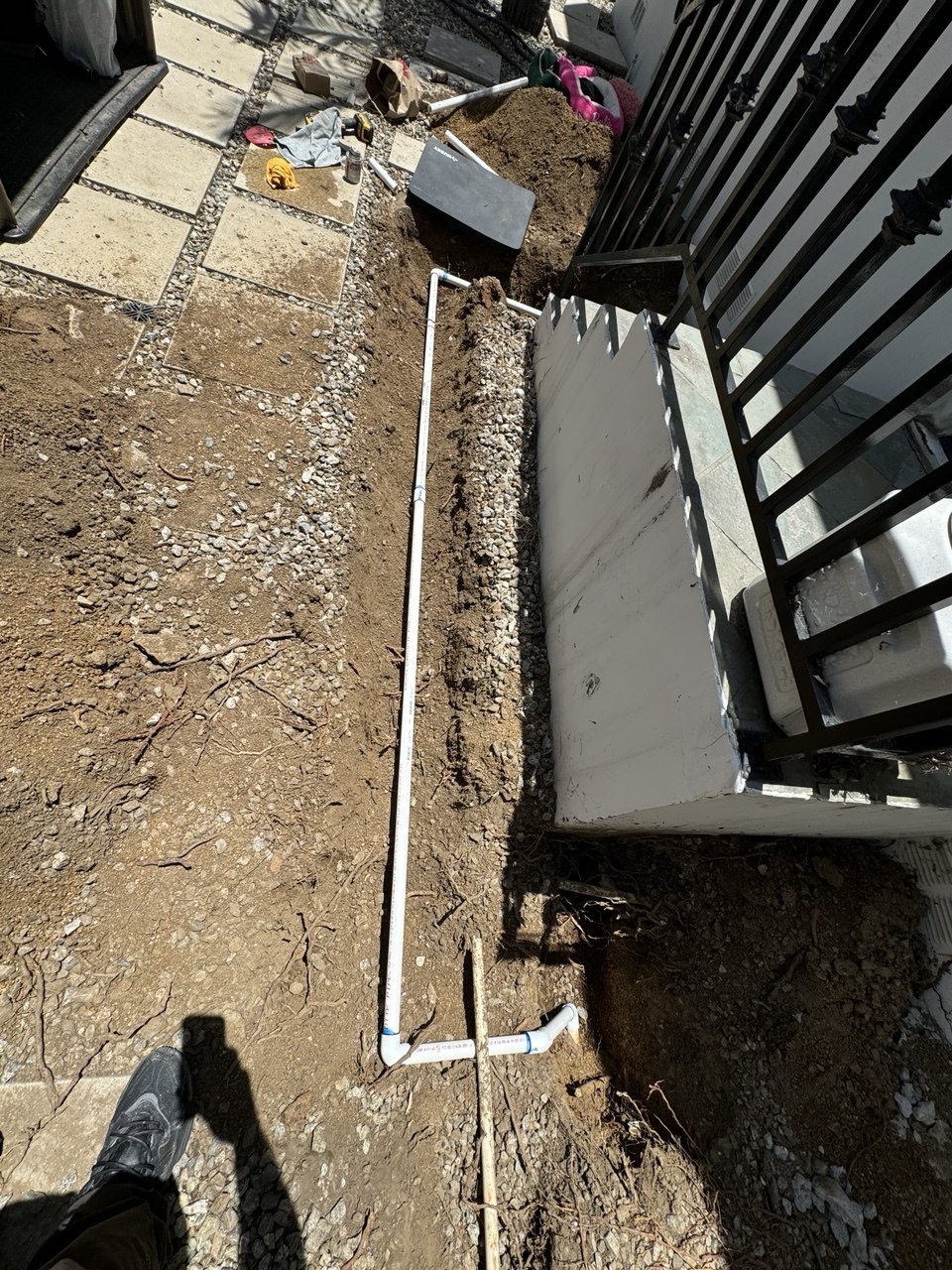
A new PVC line laid in an open trench beside a white garden wall and an iron railing, an elbow turned up at the near end. Fine roots still show in the dirt on the left.
Make sure it's the sprinklers
Turn every zone off at the controller and close every faucet in the house. Then find the water meter, usually in a concrete box near the sidewalk, and lift the lid. Many meters have a small leak indicator, a triangle or a little star wheel, that turns with even a trickle. If it's moving with everything off, the leak is on a line that holds pressure all the time. That's the main line or the house plumbing, and the last section of this guide is for you.
If it stands still, run the zone nearest the wet spot by hand from the controller. A cracked lateral usually shows itself within a few minutes. Water bubbles up at the spot, the patch spreads, or the heads on that zone rise slowly and spray short.
Read the weak zone
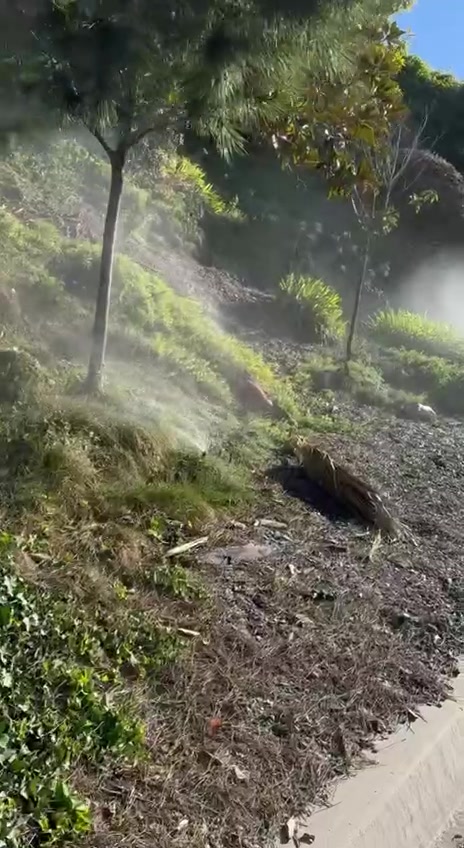
The lateral is the buried pipe from a valve out to that zone's heads. It only holds water pressure while the zone runs, which is why the wet patch dries a little between watering days and comes back after each run. Low pressure on one zone points the same way. Water takes the easiest way out, and a crack is easier than a nozzle.
Rule out the cheap causes before you dig. Many valves have a flow control handle on top, and one turned partway down makes the whole zone spray weak. A clogged filter screen weakens one head, not the whole zone. If the weak heads are all at the far end of the line, though, the break is usually somewhere before them.
Water also travels along a trench. On a slope the wettest spot can sit a few feet downhill of the crack, so start at the uphill edge of the patch.
Why the roots find the pipe
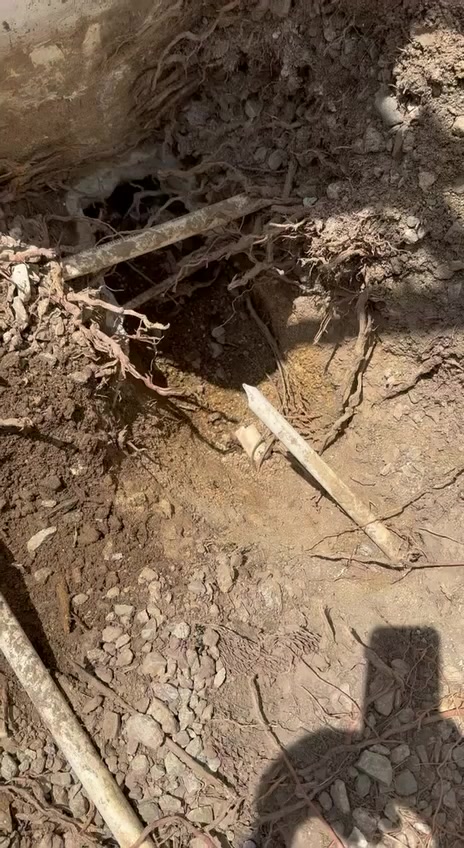
Roots go where the water is. A joint that weeps even a little keeps the soil around it damp through a dry summer, and in the hard, compacted ground most LA yards have by September, that damp strip is the easiest place for a root to grow. Fine roots wrap the pipe and work into the joint. A thicker root growing beside or under the line lifts it as the root swells, and old PVC cracks where it's pinched.
Sprinkler lines tend to run along the house and the planting beds, which is right where people plant trees. Ficus is the famous case here. Los Angeles has taken out street ficus whose roots made sidewalks impassable.
That's what we found on a recent irrigation job where we ended up rebuilding the line. The old line ran along the side of the house, and when it came out of the ground it came out in short pieces, tangled in a mat of fine roots.
Digging to the break
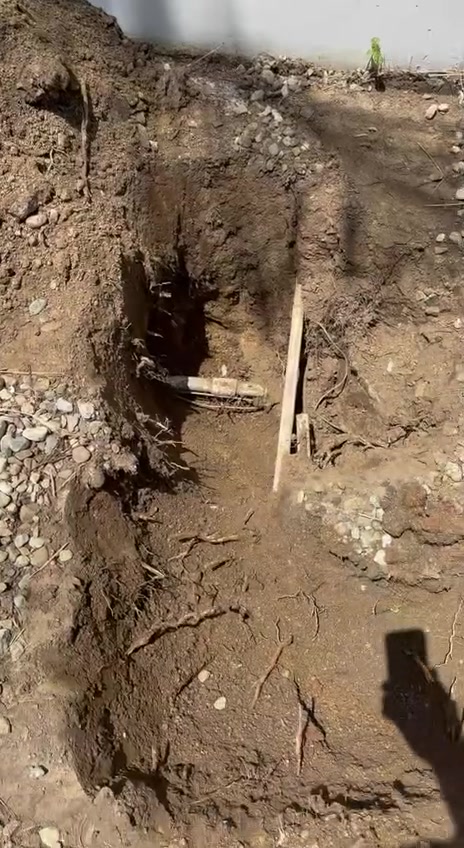
Call 811 first, or put in a request online with DigAlert. It's free, and they need at least two working days' notice before you dig.
Dig by hand and start at the wet spot, where the soil will be soft. Past it, fall ground can be hard enough to stop a shovel, so soak the line of the trench with a hose the evening before. Once you reach the pipe, follow it both ways until you find the crack, a split along its length, or a joint pulled apart.
Keep the zone set to off at the controller while the trench is open, rather than deleting it from the schedule.
The repair
A cracked lateral gets the bad section cut out and a new piece glued in, with couplings or a telescoping repair fitting that closes the gap. PVC takes primer and solvent cement, and the joint has to set before the zone runs again. The can says how long.
When roots have grown along the whole run, a patch in the middle only moves the next break a few feet down the line. On the job in these photos the answer was a new length of PVC in the trench, with new glued joints, rather than one more coupling in old pipe.
Where to stop
Finding the zone, digging to the pipe and gluing in a coupling are a fair Saturday for most people. Three things aren't.
The main line is one. Everything between the meter and the irrigation valves stays under full pressure day and night, and a break there is what the meter test in the first section finds. The repair starts with shutting off water to the house, and it's a plumber's job.
So is the backflow preventer, the brass assembly that keeps sprinkler water from flowing back into the drinking water, usually standing above ground near the valves. If it leaks or got hit, leave it to a plumber.
A big root is a question for an arborist before anyone cuts it, especially near the trunk or against the foundation. Cutting the wrong one can weaken the tree or kill it.
Until it's fixed, turn that one zone off and let the rest run on your days. In Santa Monica that's two days a week, and a cracked lateral spends one of them making a puddle.
Rather hand it over?
Tell us the job and your ZIP. You get one flat price to approve before anything starts.
Get an estimateSprinkler & Irrigation Repair we have done in Los Angeles
Real Sprinkler & Irrigation Repair jobs by Construction Hub. Our own photos, not stock, and not staged for this guide.
Read next
What sprinkler & irrigation repair costs in Los Angeles, and the guide that picks up where this one stops.
What sprinkler & irrigation repair costs in Los Angeles
Most jobs land between $120 and $450. Digging is what costs you here.
See the price breakdown
What to Check on Your Sprinklers in October
The whole fall walk around the system, from the controller to the valves. This guide picks up where its soggy spot ends.
Read the guideMore DIY guides
The rest of the yard and the house before the wet months.
You can diagnose a blocked gutter from the ground in about ten minutes.
Every guide we have written, and the point in each job where it is worth handing over.
A Wet Spot That Won't Dry, or One Weak Sprinkler Zone: FAQ
Can tree roots break a sprinkler pipe?
Yes. Fine roots wrap a pipe and work into a joint that weeps, and a thicker root growing beside the line lifts and pinches it until old PVC cracks. The leak keeps the soil damp, which pulls more roots to the same spot.
Why does only one sprinkler zone have low pressure?
If the other zones run normally, the supply is fine and the problem is on that zone. Check the flow control on its valve and the filter screens in the heads first. If those are clear, a cracked lateral is letting water out before it reaches the heads, and there's usually a soft spot somewhere along it.
I have a wet spot in the yard. Who do I call?
Do the meter test first. If the leak indicator turns with every faucet and every zone off, it's the main line or the house plumbing, and that's a plumber. If the spot only gets wetter while a zone runs, it's the sprinkler system, and that's a sprinkler repair. What moves the price is on the cost page.
Should I cut the roots around the pipe?
Thin roots wrapped around the section you're replacing can be cut back. A root as thick as your wrist, or any big root near the trunk or the house, should be seen by an arborist before it's cut.
Get the next guide by email
New how-to guides and the seasonal checklist for LA houses. No sales emails.
We'll only use your email for the guides.