
Rain Under the Door, and How to Find Where It Gets In
The first storm after a dry summer finds every gap at the bottom of a door. You come downstairs to a dark line across the floor inside the threshold, or a puddle that has climbed over the track of the patio slider, and the door looks exactly the way it did in August.
Rain here hides the problem for months. Downtown Los Angeles averages two hundredths of an inch in July and nearly two and a half inches in December, so a seal that failed in spring has had all summer to go unnoticed. Water under a door comes from a short list of places, and you can find most of them with a garden hose on a dry afternoon in October, while the wood is dry enough for caulk to stick.
Make it rain on a dry day
You need a helper and a hose with a spray nozzle. One person stands inside with a flashlight and the door closed. The other wets the outside in sections, starting low. Run the threshold first, then the bottom corners where the jamb, the side of the frame, sits on the threshold. After that, the joint where the trim meets the wall, and only then the head of the door.
Bottom up matters. Spray the top first and the water running down will show up at the bottom, and you'll fix the wrong part.
Keep the spray soft, like rain, and give each section a few minutes before you move on. Storm rain comes in at an angle, so angle the hose the way the wind hits that side of the house.
Under the door
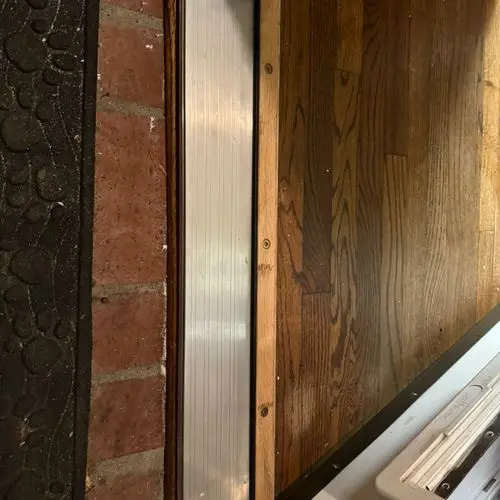
The threshold is the strip you step over. The door sweep is the rubber or vinyl seal on the bottom of the door itself. If water comes in across the whole width, those two aren't meeting. Many thresholds have an adjustable cap with screws under small round plugs, and a door with no such screws takes a new sweep instead. Our guide to a drafty door walks through both, with the dollar bill test that shows where the seal has stopped touching.
If the water shows up at one end only, look at the corners. At the foot of each jamb there's usually a corner pad, a small block of foam that closes the gap between the end of the threshold and the weatherstrip. On most newer doors that weatherstrip presses into a kerf, a slot cut into the jamb. Endura, which makes door frames, caulks that joint and then sets the pad. Pads flatten and fall out over the years, and a new one is a small part from the hardware store. Check the joint where the threshold ends against the jamb too. A crack there lets water under the threshold itself, where no sweep can stop it.
Patio sliders and the weep holes
Aluminum sliders from the 60s and 70s are all over the basin, and their sill is built to take in some water and let it out again. It drains through weep holes, small slots on the outside face of the sill, often behind a flap. Over a dry summer the track fills with grit, leaves and dead bugs, and the Santa Ana winds pack it tight. The first storm fills the track, the slots can't drain it, and the water climbs over the inside lip onto your floor.
Vacuum the track. Then clear each slot from outside with a soft brush or a pipe cleaner, which is what Milgard tells owners of its own doors to do, and go easy on the flaps. Pour a cup of water into the track and watch it run out the front. If it sits, that slot is still blocked.
People sometimes caulk those slots shut, thinking that's where the rain gets in. It's the drain. Seal it and the track turns into a tub.
Above the door
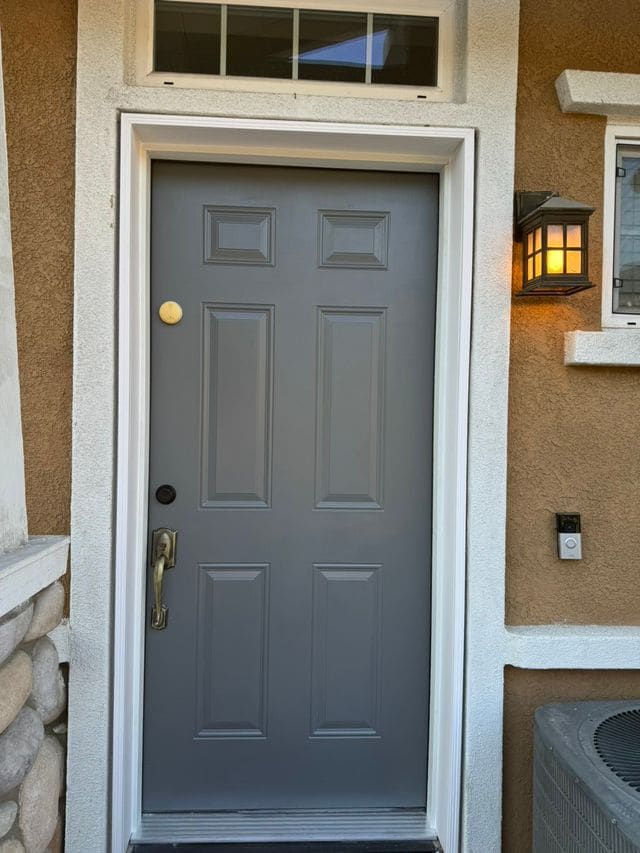
Water that shows up at the bottom can start at the top. Look over the head of the door for a drip cap, a thin metal or vinyl lip over the top trim that throws water clear of the frame. If it's missing, or bent so it tips back toward the wall, rain runs behind the trim and down inside the jamb.
Then look where the trim meets the stucco. A crack along that joint lets wind-driven rain behind the trim. Cut out the loose caulk, wipe the joint, and run a new bead of paintable exterior sealant. Leave the bottom edge of the drip cap open, and never caulk anything that moves.
One more thing to check overhead is the gutter. If the run above the door spills over in a storm, a sheet of water lands on the step and splashes straight onto the threshold, and no seal is built for that. Clearing it is often the whole fix.
The step and the slab
Next time it rains, stand outside for a minute and watch where the water goes. A porch, step or patio slab should shed water away from the door. Lay a level on it with one end at the threshold. The bubble should show the slab falling away from the house.
Slabs settle over the decades, and one that has tipped back toward the door holds a puddle against the threshold all storm long. A soaked doormat does the same thing on a smaller scale, so move it inside when the rain starts.
Where to stop
A sweep, corner pads, a threshold adjustment, clear weep holes and a bead of caulk are a fair Saturday for most people. Three things aren't.
Rot is the first. Push a screwdriver into any dark wood on the threshold, the sill under it (the frame piece the threshold sits on) or the bottom of the jamb. If it sinks in, the wood is gone, and caulk over it only hides it. The threshold and the bad section of the jamb have to come out and new ones go in, and that's a door repair before it's a seal.
Water under the floor is the second. A soft spot inside the door, boards that have cupped, or carpet that smells damp a foot in from the threshold all mean water has been getting under it for more than one season. Somebody needs to open the floor and see how far it went before anything is sealed over it.
The third is a slab that falls toward the house. A door can't win against standing water, and resetting or replacing concrete is a job for a concrete crew, not a door crew.
A sweep is an afternoon. The floor under a leaking door is not.
Rather hand it over?
Tell us the job and your ZIP. You get one flat price to approve before anything starts.
Get an estimateWhen the threshold is soft
We replace rotted thresholds and the bottom of the jamb, fit new sweeps and weatherstrip, reset corner pads and caulk the trim where it meets the stucco.
Call (310) 571-5798Read next
What weatherstripping costs in Los Angeles, and the guide that picks up where this one stops.
What weatherstripping costs in Los Angeles
Most jobs land between $90 and $200. Count of openings drives this.
See the price breakdown
A Drafty Door in LA? Find the Gap, Then Seal It
The step-by-step on the seals themselves, from the kerf weatherstrip around the frame to the threshold screws and the sweep.
Read the guideMore DIY guides
The rest of the October walk around the house, from the gutters to the outdoor outlets.
You can diagnose a blocked gutter from the ground in about ten minutes.
Every guide we have written, and the point in each job where it is worth handing over.
Rain Under the Door, and How to Find Where It Gets In: FAQ
Why does my door only leak when it rains hard?
A light rain falls on the threshold and runs off. A storm drives water sideways against the bottom of the door and the corners, and an overflowing gutter can dump a sheet of it right on the step. A seal that's only half touching holds in a drizzle and loses in wind.
Should I caulk the threshold?
Caulk the joint where each end of the threshold meets the jamb, and the joint where the trim meets the stucco. Don't caulk the weep slots on a slider, the bottom edge of a drip cap, or anything that moves, like the door edge or the weatherstrip.
Why is my sliding door leaking at the bottom?
Usually the track can't drain. Grit from the dry months blocks the weep holes on the outside of the sill, and the track fills and spills over the inside lip. Vacuum it, clear the slots from outside, and pour in a cup of water to check that it runs out.
Who do I call for a door threshold leak?
A worn sweep, a flat corner pad, a threshold that needs adjusting or one that's rotted and needs replacing is a door repair or weatherstripping job. A slab that tips toward the house is concrete work. What moves the price on a door is on the cost page.
Keep a copy
Twenty things to check around an LA house each season, on one page you can print or keep on your phone.
The PDF opens as soon as you send. We'll only use your email for the next season's list.